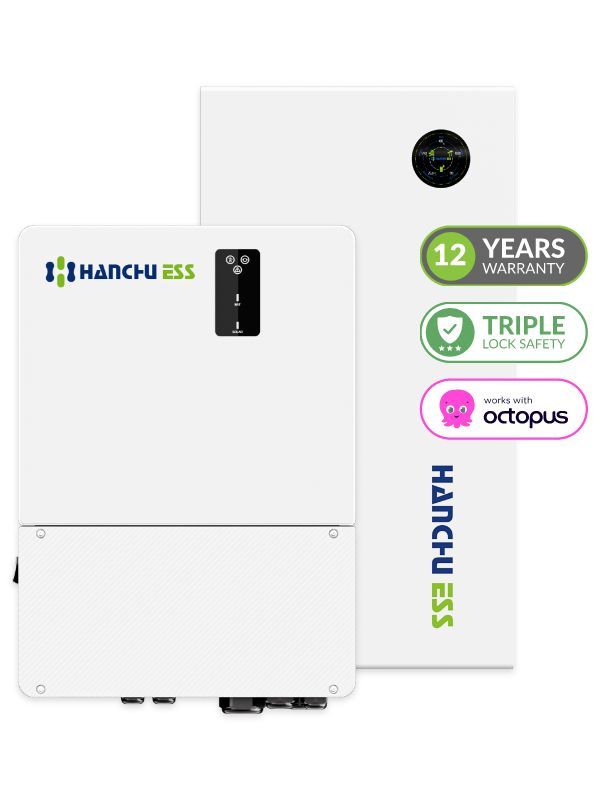
A battery system can be affordable without cutting corners.
True value comes from products that are designed intelligently from the inside out, where safety, reliability and long-term support are built in, rather than bolted on.
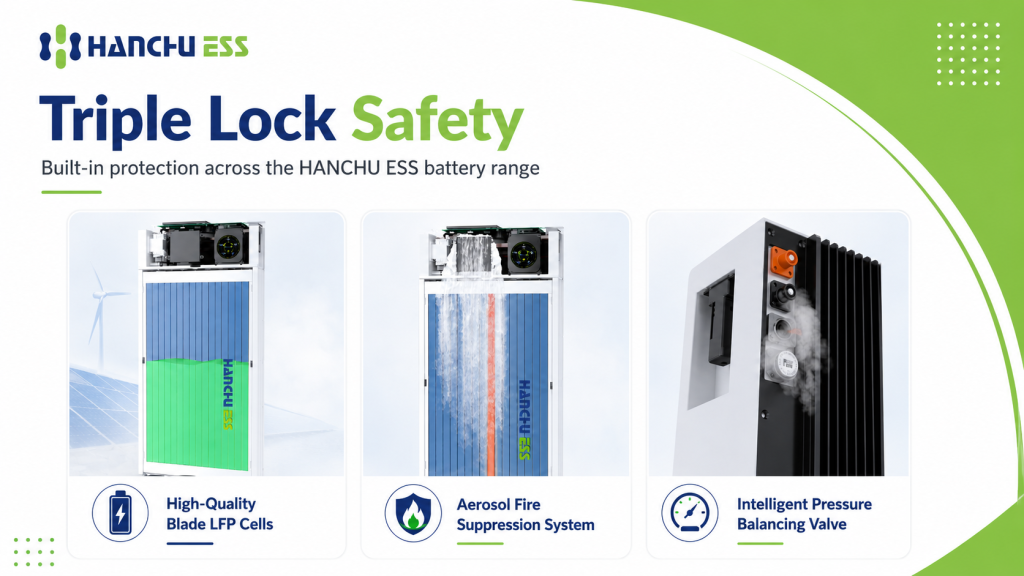
Across the HANCHU ESS battery range, Triple Lock Safety is one of the clearest examples of that design approach in action: a layered approach to battery protection built into the product, from the battery cells themselves through to the wider safety systems around them.
What is Triple Lock Safety?
Triple Lock Safety is the HANCHU ESS multi-layered battery safety system, designed to bring together three core areas of protection within the battery design.
It combines cell-level protection, internal battery stability and integrated fire suppression to support safer, more reliable energy storage without compromising performance.
Triple Lock Safety sits within a wider engineering approach built around high-quality components, stable battery chemistry, and intelligent monitoring. Rather than relying on one single safety feature, HANCHU ESS batteries are designed with multiple layers of protection working together across the system.
The exact structure of Triple Lock Safety varies slightly across the HANCHU ESS battery range. Most models use premium Lithium Iron Phosphate cells, an intelligent pressure-balancing valve, and an aerosol fire-suppression system.
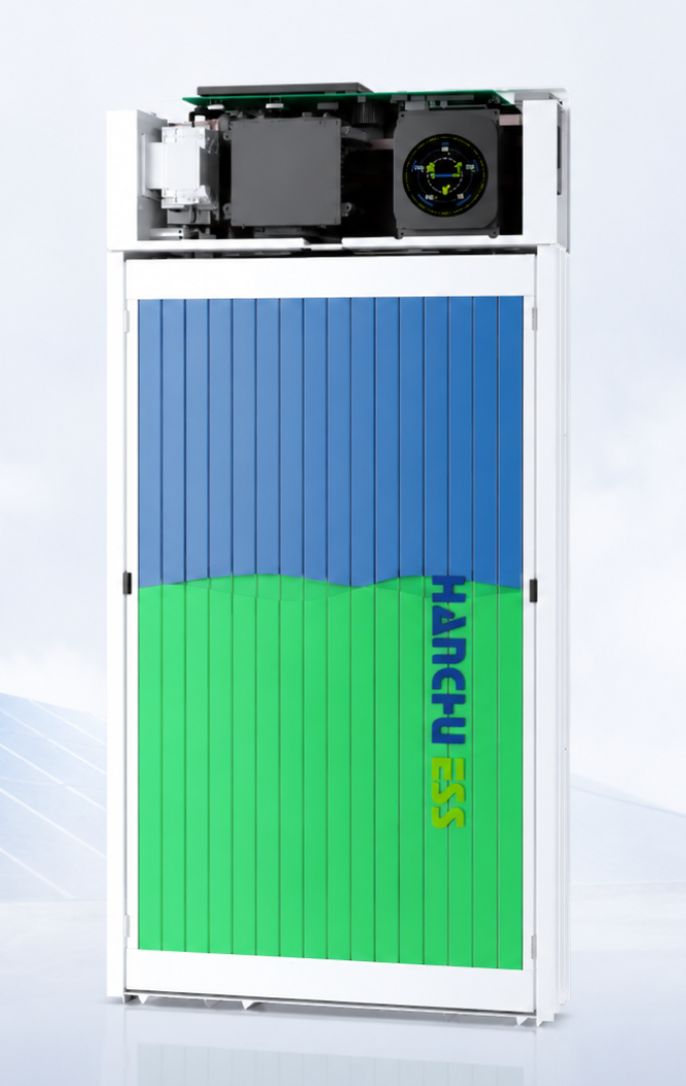
The HANCHU ESS 9.4kWh low-voltage and high-voltage batteries use premium Blade LFP cells and an advanced cooling structure, alongside an aerosol fire suppression system.
It’s a combined protection approach built into HANCHU ESS batteries to support stability, long-term performance and safety.Backed by high-quality components and intelligent BMS monitoring, it reflects a wider focus on safer, more reliable battery storage.
Layer 1
Premium LFP Cell Technology
The first layer of Triple Lock Safety starts with the battery cells, forming the foundation of the entire battery system.
Most HANCHU ESS batteries use premium Lithium Iron Phosphate cell technology, commonly known as LFP. This chemistry is widely used in battery storage because of its stability, long cycle life and suitability for stationary systems.
In the HANCHU ESS 9.4kWh low-voltage and high-voltage batteries, this cell-level protection is delivered through premium Blade LFP cells.
Blade-style LFP cells are also used in electric vehicle applications, where their stable chemistry, compact format and thermal performance make them well suited to demanding, high-use environments.
These cells are a specific cell format within Lithium Iron Phosphate battery technology. They retain the stability and long cycle-life benefits associated with LFP chemistry, while using a slim, elongated cell structure designed to support internal stability, space efficiency and thermal performance.
The second layer of Triple Lock Safety focuses on internal battery stability.
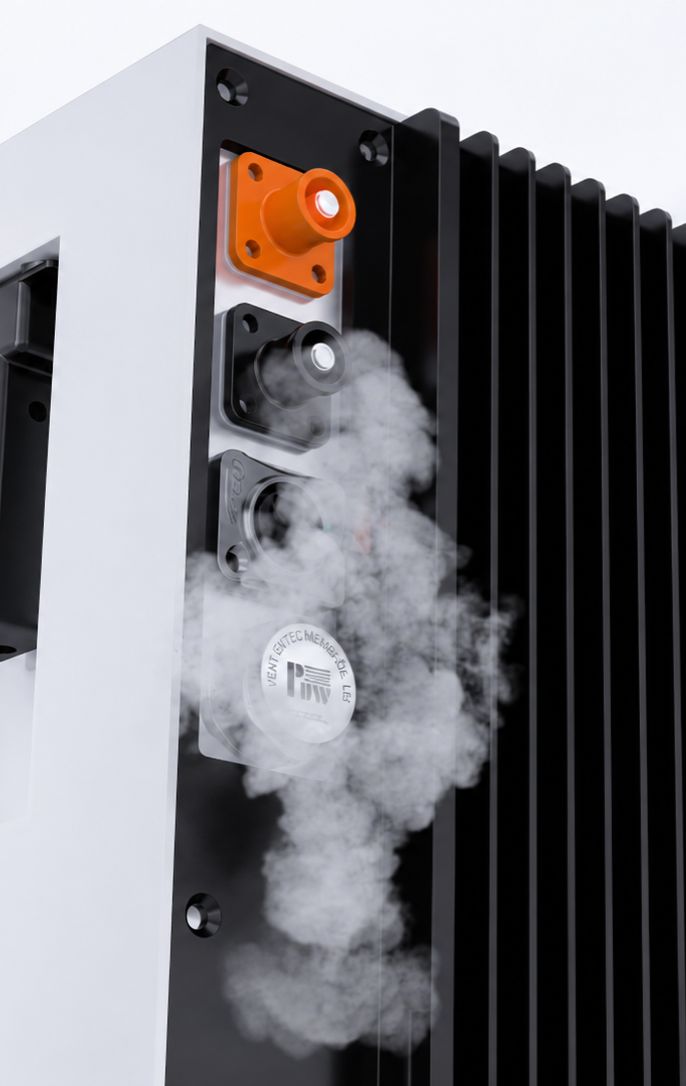
For most HANCHU ESS batteries, this comes through an intelligent pressure-balancing valve. This component is designed to help manage pressure inside the battery enclosure. If internal pressure rises to a defined level, the pressure relief port can open, releasing excess pressure from the enclosure.
As internal pressure increases, the opening area of the pressure relief port can also increase, helping the battery manage pressure more effectively and maintain a safer internal environment.
For the HANCHU ESS 9.4kWh low-voltage and high-voltage batteries, this layer is delivered through an advanced cooling structure. The bottom cooling design helps improve thermal management, supporting safer operation and long-term battery performance.
Although these features work in different ways, they serve a similar purpose: helping the battery manage internal conditions more effectively.
Layer 3
Aerosol Fire Suppression System
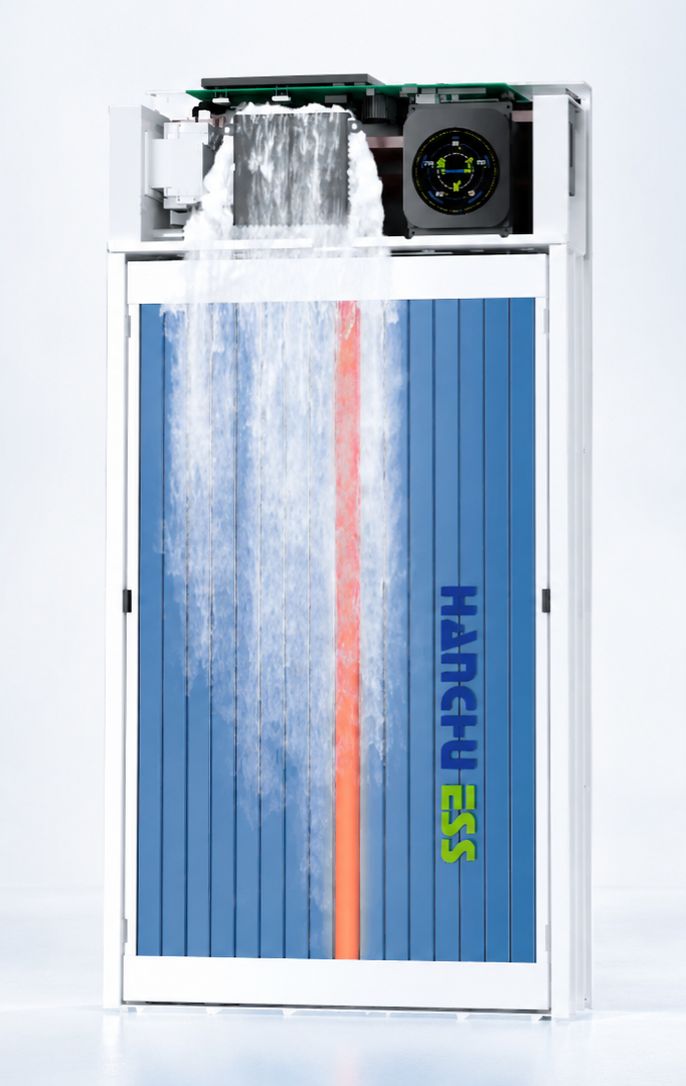
The third layer of Triple Lock Safety is the aerosol fire suppression system.
HANCHU ESS batteries include an internal protection capsule designed to deploy if an external fire is detected. This provides an additional layer of protection within the battery itself, helping the system respond to fire risk from outside the battery enclosure.
This is an important distinction.
The aerosol fire suppression system is not there to replace correct product selection, professional installation or wider site safety considerations. It is one part of a layered protection approach, working alongside cell-level safety and internal battery stability.
That is the strength of Triple Lock Safety. Each layer plays a different role, but the purpose is the same: to support safer, more reliable battery storage through protection built into the product from the start.
Supporting System
How the Battery Management System Supports Safety
While Triple Lock Safety focuses on the physical protection features built into the battery, the Battery Management System also plays an important supporting role.
The BMS continuously monitors key operating conditions within the battery, helping manage performance, protection and system stability during everyday use. This includes monitoring areas such as cell voltage, current, temperature and charge/discharge behaviour.
A key part of this is protection against abnormal operating conditions. The smart BMS helps guard against risks such as overcurrent, overvoltage, over-discharge, overheating and short-circuit conditions by keeping the battery operating within defined safety parameters.
If abnormal conditions are detected, the system can respond by limiting operation, protecting the cells or triggering safeguards designed to reduce risk.
In this sense, the BMS does not replace the three physical layers of Triple Lock Safety. Instead, it supports them by helping the battery stay controlled, balanced and protected throughout its operating life.
FAQ
Frequently Asked Questions
Answers to common questions about battery safety, Triple Lock Safety and the systems that help HANCHU ESS batteries operate safely and reliably.
What makes a home battery system safe?
A safe home battery system combines stable battery chemistry, reliable product design, correct installation, monitoring, protection systems and appropriate site conditions. In HANCHU ESS batteries, Triple Lock Safety supports this by combining cell-level protection, internal stability features and integrated fire suppression, alongside intelligent Battery Management System oversight.
Why is LFP battery chemistry used in energy storage systems?
Lithium Iron Phosphate, commonly known as LFP, is widely used in battery storage because it offers strong thermal stability, long cycle life and reliable performance for stationary energy systems. These characteristics make LFP chemistry well suited to home and commercial battery storage applications where safety, durability and long-term operation matter.
How does a battery respond if internal pressure rises?
In batteries equipped with an intelligent pressure balancing valve, the system is designed to help manage internal pressure within the battery enclosure. If pressure rises to a defined level, the pressure relief port can open to release excess pressure, helping the battery maintain a safer internal environment.
Why is thermal management important in battery storage?
Thermal management helps battery cells operate within suitable temperature ranges. This supports safer operation, consistent performance and long-term battery health. In the HANCHU ESS 9.4kWh low-voltage and high-voltage batteries, an advanced bottom cooling structure helps improve thermal management across the battery system.
Does built-in fire suppression make a battery storage system safer?
Built-in fire suppression can provide an additional layer of protection within the battery design. HANCHU ESS batteries include an internal aerosol fire suppression capsule designed to deploy if an external fire is detected. This does not replace correct product selection, professional installation or wider site safety requirements, but it does add another protective layer.
Can battery safety features reduce the risk of thermal runaway?
Battery safety features are designed to reduce risk by supporting stable operation, monitoring abnormal conditions and adding protective responses where needed. Features such as LFP chemistry, pressure management, thermal design, fire suppression and BMS monitoring can all contribute to risk reduction, but they should always work alongside correct installation and appropriate system design.
What role does the Battery Management System play in protecting battery cells?
The Battery Management System monitors key operating conditions such as voltage, current, temperature and charge/discharge behaviour. By tracking these conditions in real time, the BMS helps the battery operate within defined safety parameters and can respond to abnormal conditions by limiting operation or triggering protective safeguards.
Safety, reliability and support built in
From cell-level protection to intelligent system monitoring, HANCHU ESS batteries are designed to support dependable energy storage for homes, businesses and installers across the UK.
Explore the battery range and discover products built around safety, performance and long-term reliability.
To provide the best experiences, we use technologies like cookies to store and/or access device information. Consenting to these technologies will allow us to process data such as browsing behaviour or unique IDs on this site. Not consenting or withdrawing consent, may adversely affect certain features and functions.
Functional
Always active
The technical storage or access is strictly necessary for the legitimate purpose of enabling the use of a specific service explicitly requested by the subscriber or user, or for the sole purpose of carrying out the transmission of a communication over an electronic communications network.
Preferences
The technical storage or access is necessary for the legitimate purpose of storing preferences that are not requested by the subscriber or user.
Statistics
The technical storage or access that is used exclusively for statistical purposes.The technical storage or access that is used exclusively for anonymous statistical purposes. Without a subpoena, voluntary compliance on the part of your Internet Service Provider, or additional records from a third party, information stored or retrieved for this purpose alone cannot usually be used to identify you.
Marketing
The technical storage or access is required to create user profiles to send advertising, or to track the user on a website or across several websites for similar marketing purposes.

 Inverters
 Batteries
 Commercial
 EV Chargers
 Accessories
 Heat Pumps
 Radiators
 Greenlinx